
The discharge papers are signed and the family is finally home. Then come the questions. How much should one move? Which exercises are safe? What happens between physio appointments?
Clinic sessions usually fill only a few hours a week, so much of stroke rehabilitation happens in the living room. This guide will help you understand which stroke rehab exercises at home to start with, how often to do them and the warning signs that mean stop.
How to Keep Stroke Rehabilitation at Home Safe
Get the go-ahead first
Check with your doctor or physiotherapist first, and follow any home exercise sheet from the hospital.
Know when to stop
Muscle tiredness is normal. Chest pain, a sudden severe headache, dizziness or sharp joint pain means stop and rest. Breathe steadily, and never practise standing exercises alone while balance is shaky.
If signs of another stroke appear, think BE FAST: loss of Balance, Eye changes, Face drooping, Arm weakness or Speech trouble means it is Time to call 999.
Protect the weak shoulder
Weak muscles can let the shoulder slip partly out of its socket, so never pull on the affected arm.
How to Match Each Exercise to Your Ability
Start from what the affected limb can do today.
If the limb can’t move yet
A caregiver gently moves it through its comfortable range while the survivor tries to join in.
If it moves but can’t lift
Slide it along a table or the bed so gravity isn’t working against it.
If movement is returning
Practise without help, add slow holds, then light resistance.
Stroke Recovery Exercises for the Legs
1. Seated knee straightening
Sitting tall, straighten the affected knee until the leg is level, hold for three seconds and lower slowly. Do 10. If it won’t lift yet, a helper can support the ankle.
2. Bridging
Lie on your back, knees bent and feet flat. Lift your hips a little, hold for three seconds and lower slowly. Do five to 10 to build hip strength for standing.
3. Ankle pulls
Weak shin muscles can cause foot drop, where the toes catch the floor. With your heel down, pull your toes towards your shin, hold for two seconds and relax. Repeat 10 times.
Stroke Recovery Exercises For Arm and Shoulder
The arm often recovers more slowly, so daily practice counts.
4. Tabletop towel slides
With a towel under the affected hand, slide it forward on a table and back, then sideways and back. Do 10 of each.
5. Clasped-hand lifts
Interlace your fingers, affected thumb on top. With your stronger arm helping, lift both arms to shoulder height, no higher, and lower slowly. Repeat eight to 10 times.
6. Supported elbow bends
Rest the forearm on a table, palm up. Bend the elbow to bring your hand towards your shoulder, then straighten it. Do 10 to 15, adding a small water bottle later.
Stroke Recovery Exercises For the Hand
7. Wrist lifts
Rest your forearm on a table, hand over the edge and palm down. Lift the hand, hold for two seconds and lower. Do 10, then repeat palm up.
8. Fist to fan
Make a gentle fist, then spread your fingers wide. Repeat 10 times, then touch your thumb to each fingertip. Opening matters as much as closing, as fingers often curl after a stroke.
9. Pick-up practice
Pick up 10 coins or dried beans one at a time and drop each into a cup, which helps train the grip for buttons and cutlery.
Stroke Recovery Exercises For Balance and Core
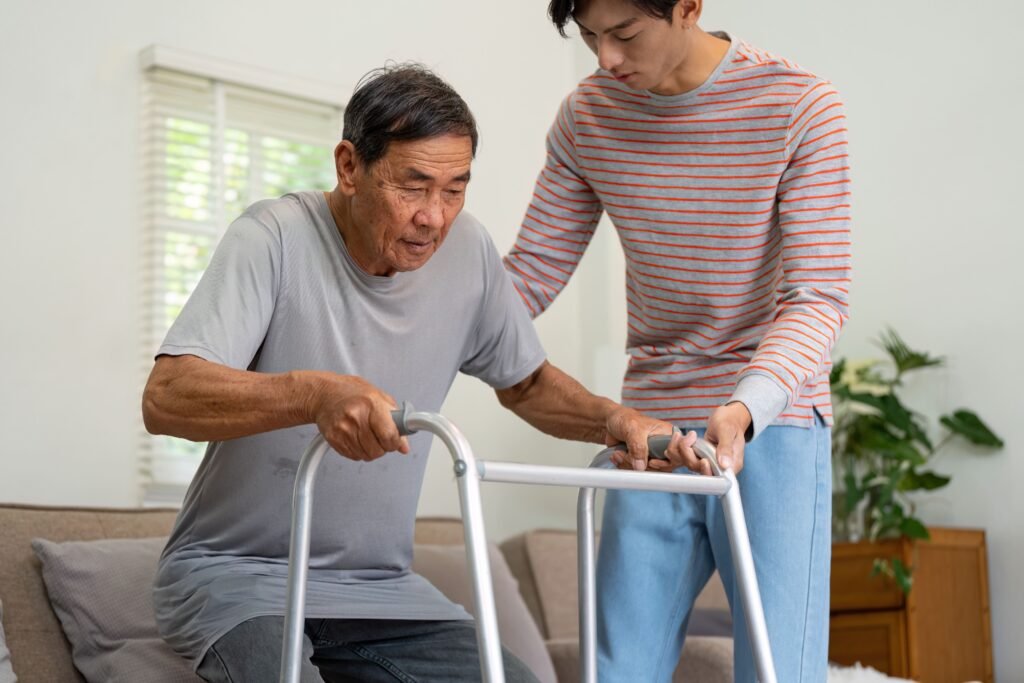
Do these beside a kitchen counter, with someone within arm’s reach.
10. Seated weight shifts
Sitting on a firm chair, lean slowly to one side until your weight moves onto that hip, then the other. Do 10 each side.
11. Sit to stand
From a chair with armrests, place your feet slightly behind your knees, lean forward, nose over toes, and stand. Reach back for the armrests and sit slowly. Build from five to 10.
12. Supported standing weight shifts
Facing the counter with both hands on it, shift your weight onto the affected leg, hold for five seconds and shift back. Repeat 10 times, then try one hand.
How Often Should You Do Stroke Rehab Exercises at Home?
Start with one or two sets of 8 to 15 repetitions on most days, adjusted by your physiotherapist. Two or three short sessions a day are often easier than one long one, as post-stroke fatigue is common. Stop when your form starts to slip.
Daily tasks count too, like holding a cup with the affected hand or three sit-to-stands before meals. There is no shortcut, but regular practice gives the brain more chances to relearn. For timelines, see what to expect from physiotherapy after a stroke.
When Home Exercises Aren’t Enough
Home practice works best alongside regular reviews. Book a physiotherapy check if progress stalls for several weeks, the limb grows stiffer, shoulder pain worsens or there has been a fall.
There is no single best therapy for stroke recovery. What tends to help most is a tailored mix of guided practice, hands-on treatment and tools such as EMS therapy, which uses mild electrical pulses to activate weak muscles. A structured stroke rehabilitation programme brings these together.