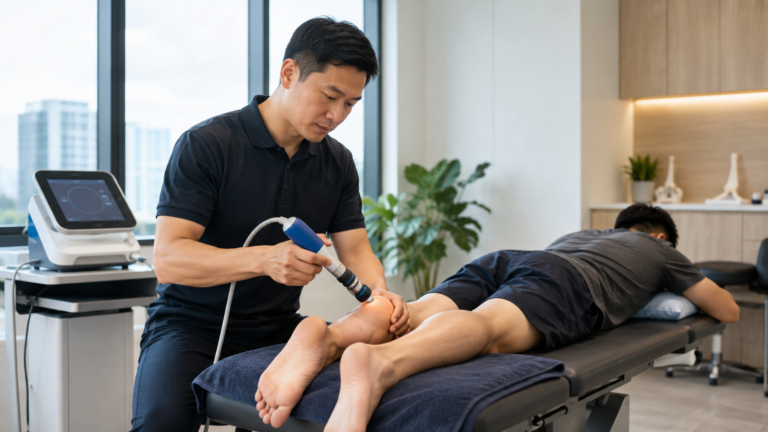

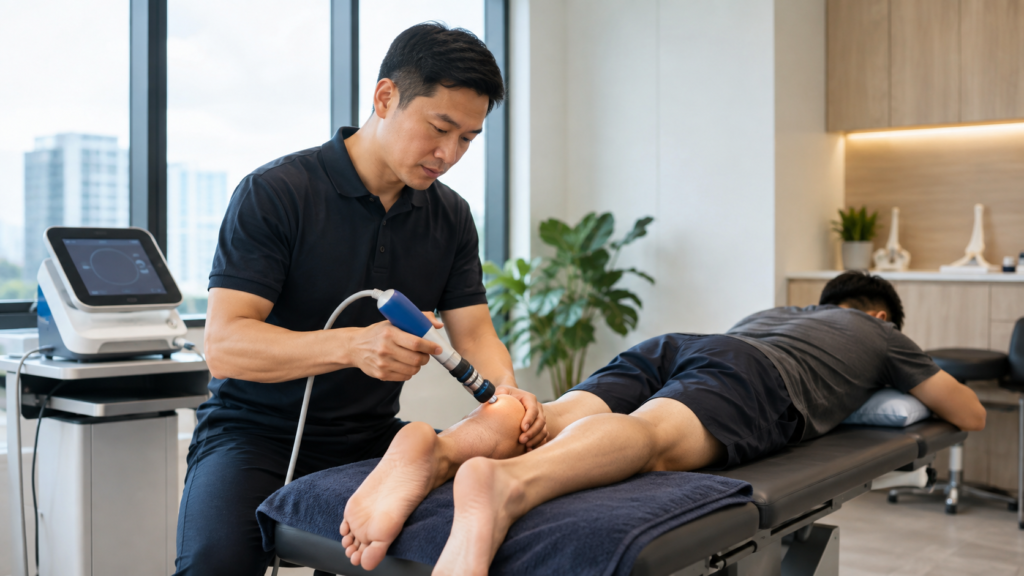
If heel pain keeps returning despite weeks or months of rest, the problem may no longer be something that simply needs more time off. Shockwave therapy for plantar fasciitis is a non-invasive treatment commonly considered for persistent heel pain that has not improved sufficiently with exercises, footwear changes, activity modification, or other conservative treatments.
Instead of simply reducing pressure on the foot, shockwave therapy delivers acoustic waves to the affected plantar fascia. The aim is to stimulate a biological response within the tissue while physiotherapy helps rebuild the foot’s strength and ability to tolerate load.
What Is Plantar Fasciitis? 

Plantar fasciitis is a painful condition of the plantar fascia.The plantar fascia is a strong band of connective tissue running from your heel towards your toes. It helps support the arch of your foot and absorbs stress whenever you stand, walk, or run.
When this tissue becomes repeatedly overloaded, small areas of irritation and tissue change can develop around its attachment to the heel.
Common symptoms include:
- Sharp pain underneath the heel
- Pain during the first few steps in the morning
- Heel pain after sitting for a long period
- Pain that improves after warming up but returns later
- Discomfort after prolonged standing, walking, or running
- Tenderness around the bottom or inner part of the heel
Although commonly called plantar fasciitis, persistent cases are increasingly described as plantar fasciopathy because chronic symptoms may involve degenerative tissue changes rather than ongoing inflammation alone. NICE similarly describes chronic plantar fasciitis as involving degeneration of the plantar fascia and notes possible microtears, inflammation, or fibrosis.
Why Chronic Plantar Fasciitis Does Not Heal on Its Own
Rest is the right first response to acute plantar fasciitis. Reducing load allows the initial inflammatory response to settle. The problem is that once the condition becomes chronic, rest is no longer enough and often is not even the right tool.
What Happens to Plantar Fascia Tissue Over Time
In chronic plantar fasciopathy, the tissue may become thickened, disorganised, and less effective at repairing itself. Rather than ongoing inflammation, the problem often involves degenerative tissue changes and reduced healing activity. Removing stress alone does not rebuild the structure. Hence, this is where treatments such as shockwave therapy may help stimulate a new healing response.
Why Stretching Helps But Only to a Point
Plantar fascia and calf stretching can reduce stiffness and ease first-step pain, especially in the morning.
However, stretching alone may not be enough for chronic plantar fasciopathy. It can help manage symptoms, but persistent cases may also require treatments and strengthening exercises aimed at improving the tissue’s capacity and recovery.
How Does Shockwave Therapy Help Plantar Fasciitis?
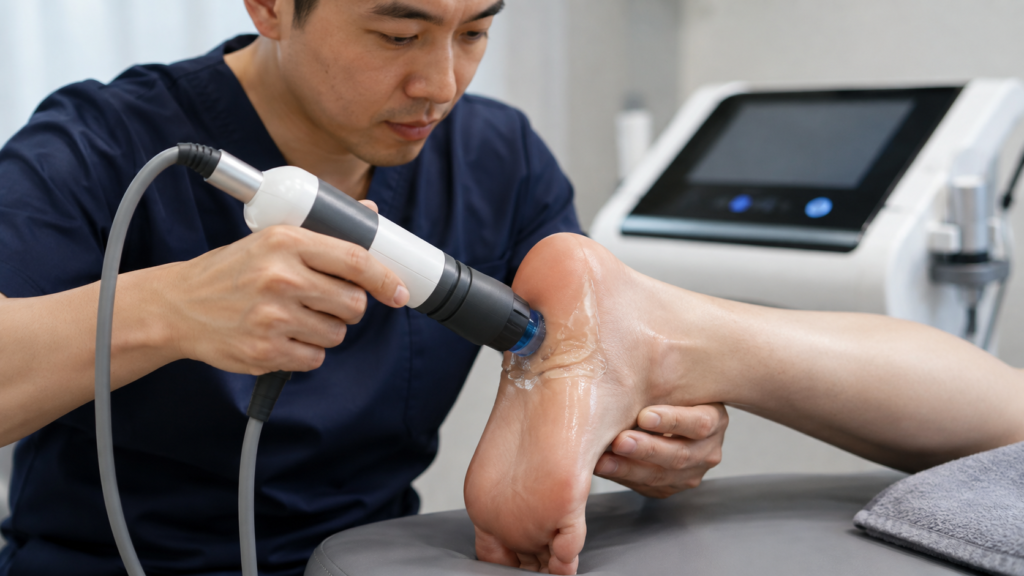
Extracorporeal Shockwave Therapy (ESWT), uses a handheld device to deliver acoustic pressure waves through the skin towards the painful area of the plantar fascia. If you want to understand how shockwave therapy works and what it treats in more detail, our guide explains the treatment process, common conditions treated, and what to expect during a session.
There are no needles, incisions, or electrical shocks involved. The exact biological mechanism is still being investigated, but shockwave therapy is thought to influence local circulation, pain signalling, and tissue-remodelling processes. NICE notes that the precise mechanism remains uncertain, while Mayo Clinic describes shockwave therapy as using sound waves with the aim of supporting blood flow and the healing process.
The important distinction is that shockwave therapy is not simply designed to numb the heel temporarily. It is generally used as part of a programme aimed at changing how the painful tissue responds over time.
Why Shockwave Therapy May Help When Rest Hasn’t
1. It Provides a Different Stimulus to the Tissue
Rest removes stress from the plantar fascia. Shockwave therapy does the opposite in a controlled way as it applies mechanical acoustic energy to the affected area. For persistent cases where simply reducing activity has not solved the problem, this different type of stimulus may help promote changes within the tissue.
2. It Can Help Reduce Persistent Heel Pain
One of the main goals of shockwave therapy is to reduce pain enough for patients to move and participate more comfortably in rehabilitation. This matters because exercises that progressively strengthen the foot and lower leg are often an important part of longer-term recovery.
3. It Does Not Require Surgery or Injections
Shockwave therapy is performed externally through the skin. There is normally no incision, injection, or surgical recovery period involved, making it an option that may be considered before more invasive procedures in appropriately selected patients.
4. It Works Alongside Rehabilitation
Shockwave therapy should not replace strengthening and load management. Instead, it can be incorporated into a wider rehabilitation programme that addresses the reasons the plantar fascia became overloaded in the first place.
What Should You Do Alongside Shockwave Therapy?
Shockwave therapy works best when combined with the right rehabilitation. Progressive loading helps the plantar fascia rebuild strength and tolerate normal activity again.
Calf and Plantar Fascia Loading

Your physiotherapist may prescribe progressive calf and plantar fascia exercises based on your strength and pain levels. These exercises are designed to gradually improve tissue capacity rather than simply stretch the foot.
Footwear and Load Management
Avoiding barefoot walking on hard tile or marble floors can help reduce repeated stress on the plantar fascia. Supportive footwear or house slippers with arch support may be useful during recovery.
How Physiotherapy Supports Shockwave Therapy at TIO
At TIO Chiro & Physio, shockwave therapy is combined with physiotherapy, including strengthening, manual therapy, mobility work, and gait advice where needed. This helps address both the painful tissue and the factors contributing to repeated overload.
When Should You Get Your Heel Pain Assessed?
Consider having your heel assessed if:
- Pain has persisted for several weeks or months
- Morning heel pain is getting worse
- Symptoms repeatedly return after rest
- You have reduced your activities significantly because of pain
- You cannot comfortably walk or exercise
- Home stretches have not improved the problem
- You are unsure whether the pain is actually plantar fasciitis
Not every case of heel pain comes from the plantar fascia. Other conditions can produce similar symptoms, which is why confirming the source of the pain before starting shockwave therapy is important.