


Most Malaysians write off back pain as part of life. You sit too long, you sleep wrong, you carry something heavy and then your back aches for a few days. You rest, pop a painkiller, and carry on.
That works fine for ordinary muscle soreness. But when the pain is coming from a slipped disc, rest alone rarely fixes it. And the longer you wait, the harder recovery becomes.
The tricky part? A slipped disc does not always feel the way people expect. It does not always announce itself with dramatic, debilitating pain. Sometimes it starts quietly dull ache here, a strange tingling there and slowly gets worse over weeks or months before people realise something is genuinely wrong.
Here are seven warning signs that your lower back pain may be more than a muscle strain, and why each one deserves attention if you suspect a slipped disc.
What Is a Slipped Disc, Exactly?
Your spine is made up of 33 vertebrae stacked on top of each other, cushioned between each pair by a small, rubbery disc. Each disc has a tough outer ring and a soft, gel-like centre.
A slipped disc clinically known as a herniated or prolapsed disc that happens when the soft inner material pushes through a crack in the outer ring. When that happens, the disc can press against nearby spinal nerves, causing pain, numbness, or weakness that may radiate far beyond the back itself.
It is one of the most common causes of lower back pain in Malaysia, particularly among adults between 30 and 55 who spend long hours sitting at a desk, driving in heavy KL traffic, or doing repetitive physical work.
7 Warning Signs That Your Back Pain May Be a Slipped Disc
1. The Pain Shoots Down One Leg
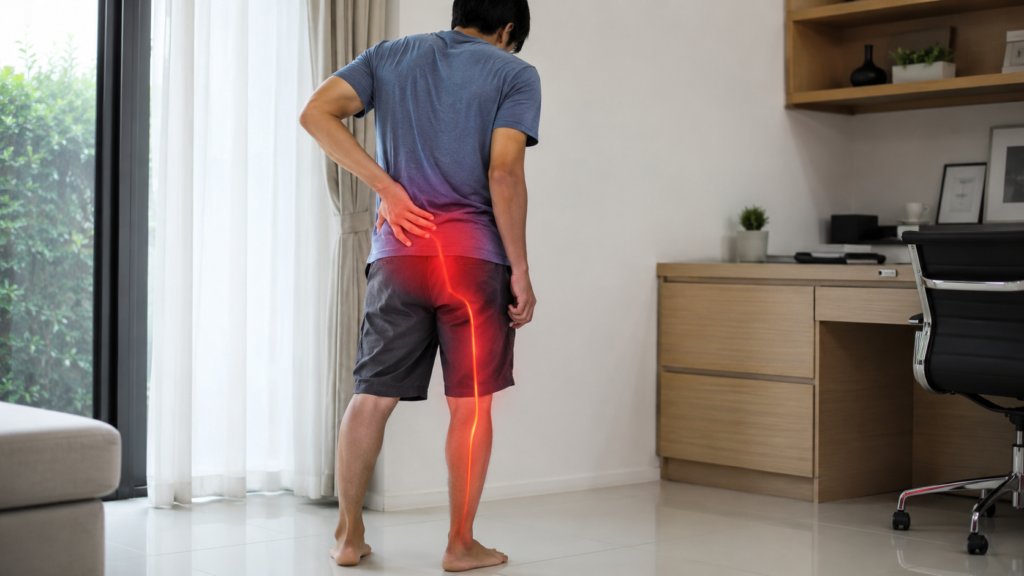
Normal lower back pain often stays around the back, hips, or waist area. But if your pain shoots from your lower back into your buttock, thigh, calf, or foot, it may be linked to nerve irritation.
This is commonly known as sciatica and it affects one side of the body at a time. A slipped disc in the lower back can press on or irritate the sciatic nerve, causing sharp, burning, or electric-like pain down one side of the body.
Ordinary muscle soreness stays in the back. If the pain keeps travelling down your leg, don’t ignore it.
2. Numbness or Tingling in Your Leg or Foot

Along with radiating pain, a compressed spinal nerve often produces numbness, a loss of sensation or that familiar pins-and-needles tingling, usually felt in the thigh, calf, or foot on the affected side.
Some people describe it as part of their leg “falling asleep” on and off throughout the day. Others notice it only when sitting for extended periods which in a country of long working hours and commutes, is easy to dismiss as poor circulation or the wrong chair.
If the numbness comes and goes consistently in the same area, and is accompanied by back pain, get it checked.
3. Muscle Weakness in One Leg or Foot
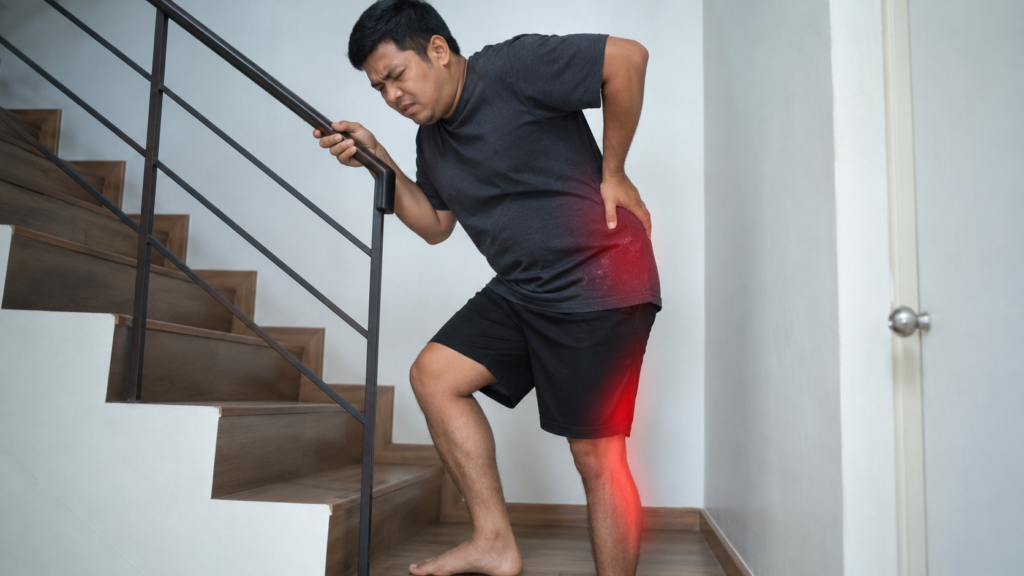
A slipped disc that presses on the nerve controlling your leg muscles can cause noticeable weakness. You may find it harder to lift your foot when walking, a symptom sometimes called “foot drop” or you might feel your leg give way unexpectedly when climbing stairs.
This type of weakness is neurological in origin. It is not the same as the general fatigue you feel after a long day. If one leg feels significantly weaker than the other, that signals nerve involvement and needs professional evaluation, not just rest.
4. Pain That Worsens When You Sit or Bend Forward

Muscle soreness tends to ease when you rest in a comfortable position. Disc pain often does the opposite.
Sitting especially for prolonged periods increases the pressure inside your spinal discs. So does bending forward. Many people with a slipped disc find that sitting at a desk for more than 20 to 30 minutes becomes unbearable, while standing or walking actually brings some relief.
If you dread getting back to your chair after a bathroom break, or if leaning forward to pick something off the floor sends pain shooting through your back and leg, that pattern is a red flag worth taking seriously.
5. Pain That Is Worse in the Morning and Eases Later in the Day (or Vice Versa)
The timing and rhythm of your pain can reveal a lot about its source.
A slipped disc often causes pain that follows a predictable daily pattern. Some people feel stiffest and most painful first thing in the morning, before easing slightly once they move around. Others feel fine when they wake up but deteriorate significantly after a few hours at a desk.
Neither pattern is “normal” for run-of-the-mill muscle soreness, which tends to be more consistent throughout the day and improves steadily as the muscle heals. If your back pain has a clear, repeating cycle, especially one linked to sitting or certain movements, it is worth understanding why.
6. Back Pain With No Clear Injury or Trigger
People often assume a slipped disc only happens after a dramatic incident such as lifting something extremely heavy, a sports collision, a fall. In reality, many disc herniations develop gradually from years of accumulated stress on the spine: prolonged sitting, poor posture, repetitive bending, or simply the natural degeneration that begins in most adults from their mid-30s onwards.
If you are experiencing persistent lower back pain but cannot point to a specific injury that caused it, do not assume the pain is minor just because there was no clear trigger. Disc damage can build quietly for a long time before reaching a tipping point.
7. Symptoms That Have Lasted Longer Than 4 to 6 Weeks
Back pain from a muscle strain typically improves within two to four weeks with rest and gentle movement. If your back pain has not meaningfully improved after six weeks or if it seemed to get better and then came back that recovery timeline is itself a warning sign.
Persistent back pain that cycles between flare-ups and partial relief, rather than resolving cleanly, suggests that the underlying cause has not been addressed. Disc problems rarely heal on their own without the right intervention, and waiting longer often means the issue progresses.
When Back Pain Becomes an Emergency
Most slipped disc symptoms, while painful and disruptive, are not medical emergencies. However, there are situations where you should seek immediate care without delay:
- Loss of bladder or bowel control such as difficulty urinating, or accidental leakage is a sign of a rare but serious condition called cauda equina syndrome, where nerves at the base of the spine are severely compressed. This requires urgent medical attention.
- Sudden, severe weakness in both legs simultaneously, particularly if you also feel numbness in the groin area.
- Back pain accompanied by fever indicates infection rather than a disc issue.
If you experience any of the above, go to the emergency department. These are not symptoms to observe at home.
So What Should You Do If You Recognise These Signs?

The first step is getting an accurate diagnosis. Back pain that involves nerve symptoms radiating leg pain, numbness, weakness is best evaluated with a clinical examination and, where needed, an MRI scan. X-rays can show bone structure, but they cannot image spinal discs or soft tissue. An MRI gives the clearest picture of what is actually happening.
If a slipped disc is confirmed, surgery is rarely the first answer. Most cases respond well to a structured, non-surgical approach combining chiropractic care and physiotherapy addressing both the disc itself and the supporting muscles that bear the load on your spine.
At TIO Chiro & Physio, our team assesses each patient’s specific condition before recommending any treatment plan. The goal is not just pain relief but identifying and correcting the underlying cause, so the problem does not keep coming back.
The earlier you seek proper care, the better your options and your outcome.