

Your shoulders creep forward while you answer emails. Your chin moves closer to the laptop. By late afternoon, the back of your neck feels tight and a dull headache has started working its way towards your temples. You stretch for a few seconds, sit upright and feel slightly better. Twenty minutes later, you are back in the same position.
This pattern is commonly described as tech neck or text neck. It refers to neck discomfort associated with spending long periods looking down at phones, laptops and other screens. It is not a formal medical diagnosis, but it is a useful way to describe a growing collection of posture-and screen-related symptoms.
Tech neck may involve more than a stiff neck. For some people, it can be accompanied by shoulder tension, restricted movement and recurring headaches. However, not every headache that happens during screen use comes from the neck, which is why understanding the pattern matters.
What Is Tech Neck?
Tech neck develops when the head stays forward or tilted down for long periods. This increases the demand on the muscles, joints and other structures of the cervical spine.
The neck is designed to move, not remain fixed for hours. Symptoms are more likely when the upper back rounds, the head sits in front of the shoulders and the body gets few opportunities to change position.
Common causes include:
- Looking down at a phone held near the lap
- Working on a laptop placed too low
- Leaning towards a monitor to read small text
- Sitting without back or arm support
- Using screens positioned at different heights
- Working for hours without standing or walking
Screen use itself is not necessarily the problem. The bigger issue is repeated, prolonged positioning combined with muscle fatigue and limited movement.
Who Is Most at Risk in KL?
Anyone who spends much of the day looking at a screen may develop tech-neck symptoms. Office workers, remote workers, students and commuters can all spend hours looking down at laptops or phones. Common symptoms include neck stiffness, tight shoulders, pain between the shoulder blades, reduced movement and headaches after screen use. Tingling, numbness or pain travelling into an arm deserves assessment.
Why Can Neck Pain and Headaches Happen Together?

The neck and head are connected through muscles, joints and nerves. Pain signals from the upper neck can sometimes be felt in the head. This is called referred pain. Several headache patterns can involve neck discomfort, but they are not the same.
Cervicogenic Headache
A cervicogenic headache is head pain associated with a problem in the neck or surrounding tissues. It may begin around the neck or base of the skull, travel towards one side of the head and reach the temple, forehead or area behind the eye. It may worsen with certain neck movements and appear alongside restricted movement. Neck tension alone, however, does not confirm the diagnosis.
Tension-Type Headache
A tension-type headache often feels like pressure or tightness around the head, sometimes described as a band across the forehead or temples. Stress, poor sleep, prolonged concentration, jaw clenching and shoulder tension may contribute. Unlike a typical cervicogenic headache, the pain is often felt on both sides.
Migraine
Migraine may also involve neck pain or stiffness, but this does not always mean the neck caused it. Migraine is more likely when the headache includes nausea, sensitivity to light or sound, visual disturbance or throbbing pain. For some people, neck discomfort is part of the migraine episode itself. Understanding the headache pattern is therefore more useful than assuming every screen-related headache is tech neck.
Signs Your Headache May Be Neck-Related
A headache may have a stronger neck-related component when:
- It appears after prolonged desk or phone use
- It begins near the neck or base of the skull
- Turning or tilting the head makes it worse
- Neck stiffness appears at the same time
- The pain repeatedly affects the same side
- Moving or changing position gives temporary relief
These signs cannot confirm the cause alone. A headache diary may help: record when the pain begins, how long it lasts, what happened beforehand and whether nausea, light sensitivity, dizziness or arm symptoms were present.
6 Warning Signs Your Neck Pain Needs More Attention
Neck stiffness and soreness at the end of a long day is unpleasant, but it is not necessarily alarming. These six signs, however, indicate that the problem may have progressed beyond ordinary muscular fatigue and deserves professional assessment.
1. Pain or Numbness That Travels Down Your Arm
Pain, tingling or numbness spreading from the neck into the shoulder, arm or hand may indicate nerve irritation. Weakness, reduced grip strength or difficulty using the hand should also be assessed. These symptoms can sometimes be associated with irritation or compression of a cervical nerve. Where a disc problem is suspected, an assessment can determine whether a more specific slipped disc treatment plan is appropriate.
2. Headaches That Keep Returning
A headache that repeatedly follows sitting or screen use may have a neck-related component, especially if movement helps. Morning headaches can have other causes and should not automatically be blamed on posture.
3. Clicking or Grinding With Pain
Neck clicking is common and often harmless. However, clicking or grinding accompanied by pain, stiffness or reduced movement is worth checking, particularly when it is becoming more noticeable.
4. Dizziness or Nausea With Neck Pain
Dizziness or nausea has many possible causes. When it appears with neck pain or movement, a clinician should determine whether the neck is involved or medical referral is needed.
5. Pain That Is Not Improving
Simple muscular soreness often improves after changing workload and movement habits. Pain that continues for several weeks, repeatedly returns or gradually worsens may need structured rehabilitation.
6. Weakness or Clumsiness in Your Hands
Dropping objects, struggling with buttons or noticing unusual weakness or poor coordination needs prompt assessment. These symptoms are not typical of straightforward tech neck.
A Five-Minute Tech-Neck Reset
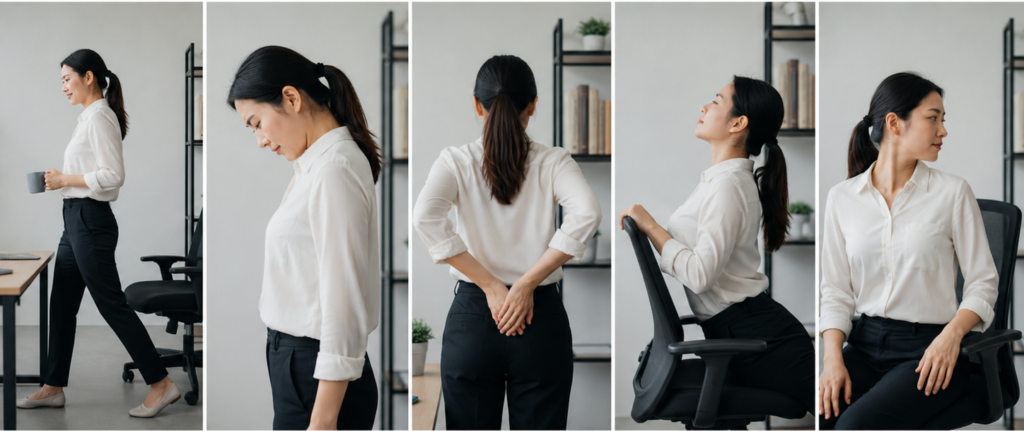
The aim of a movement break is not to force your neck into place. It is simply to give tired muscles and joints a change of position.
Try this gentle sequence after a long period of screen use.
1. Step Away From the Screen
Stand up and walk for one or two minutes. Let your arms move naturally rather than immediately checking your phone.
2. Gentle Chin Tucks
Look straight ahead and slowly draw your chin backwards, as though making a small double chin. Do not look down or force the movement. Hold briefly, relax and repeat five to eight times.
3. Shoulder-Blade Squeezes
Relax your shoulders and gently draw your shoulder blades towards each other. Avoid lifting your shoulders towards your ears. Hold for two or three seconds and repeat eight to ten times.
4. Upper-Back Extension
Sit against a chair with a supportive backrest. Place your hands behind your head and gently lean your upper back over the back of the chair. Keep the movement comfortable and avoid forcing your neck backwards.
5. Slow Neck Rotation
Turn your head slowly to one side until you feel a mild, comfortable stretch. Return to the centre and repeat on the other side. Stop the exercise if it causes sharp pain, dizziness, nausea, worsening headache, numbness or pain travelling into an arm.
These movements are general examples rather than a personalised treatment programme. Exercises may need to be modified when there is a previous injury, nerve irritation, severe pain or another health condition.
When Home Fixes Are Not Enough — Treatment Options in KL
Chiropractic Care
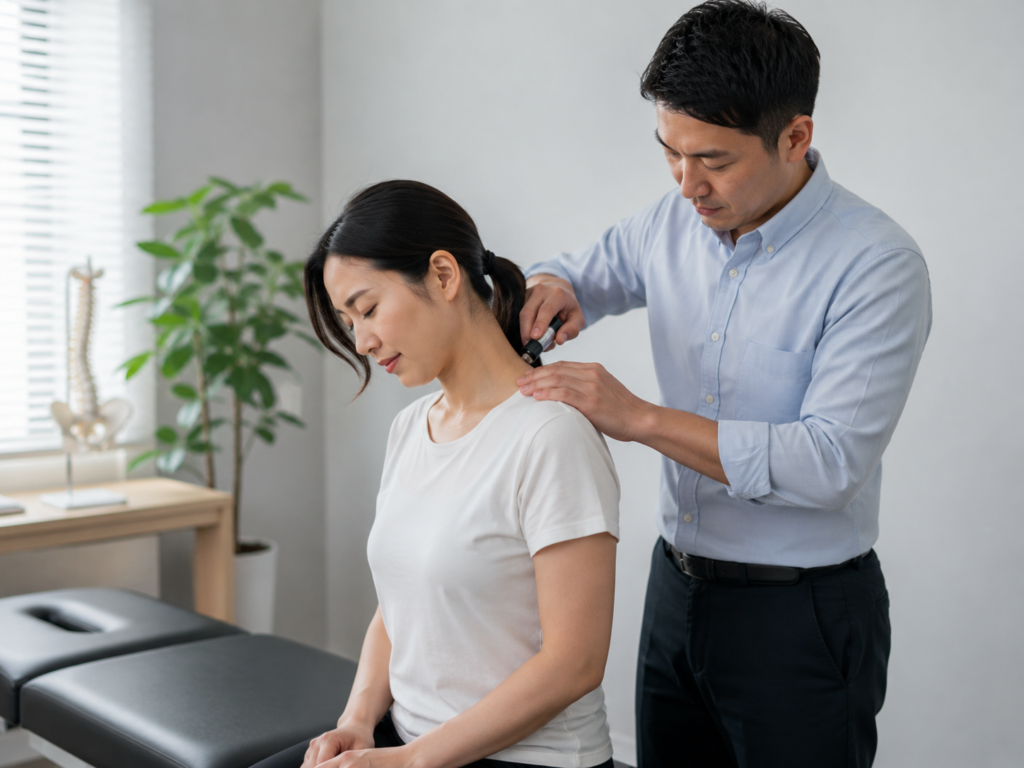
Chiropractic care for neck pain and cervicogenic headaches may help improve restricted movement by restoring mobility to the cervical joints that have become restricted under sustained forward head loading, reducing irritation to the nerve structures associated with cervicogenic pain, and correcting the postural patterns that perpetuate the problem. Gentle cervical mobilisation rather than high-velocity rotation is typically used for upper cervical work, and the approach is adapted to each patient’s assessment findings.
The Activator Method, which uses a precise, low-force instrument rather than manual thrust, is particularly well-suited to patients who are apprehensive about neck adjustment or who have specific cervical joint sensitivities. It delivers targeted joint stimulation with a high degree of control, and is one of several techniques available through the chiropractic care programme at TIO Chiro & Physio.
Physiotherapy

Physiotherapy for tech neck focuses on the muscular side of the equation that chiropractic care does not directly address. This means progressive deep neck flexor strengthening to rebuild the stability the forward head position has eroded, postural retraining to reset the default head position, and manual therapy to release the trigger points in the upper trapezius and suboccipital muscles that are sustaining both the neck pain and the referred headache.
Dry needling of the suboccipital muscles and upper trapezius is one of the most effective tools available for breaking the trigger point cycle that underlies cervicogenic headache. For patients who have carried these headaches for months, the response to targeted dry needling therapy is often faster than any other single intervention.
Why TIO Uses Both
Chiropractic care restores joint mobility and reduces nerve irritation. Physiotherapy rebuilds the muscular architecture needed to maintain the corrections that chiropractic achieves. Applied independently, each produces improvements. Applied together, within a coordinated treatment plan, they address the structural and neuromuscular dimensions of tech neck simultaneously which is why the outcomes of an integrated approach consistently outpace either discipline alone.
At TIO Chiro & Physio, patients presenting with neck pain and headaches are assessed across both dimensions before any treatment begins. A personalised assessment helps determine whether the symptoms are mainly coming from the joints, muscles, nerves, workplace habits or a separate headache condition.